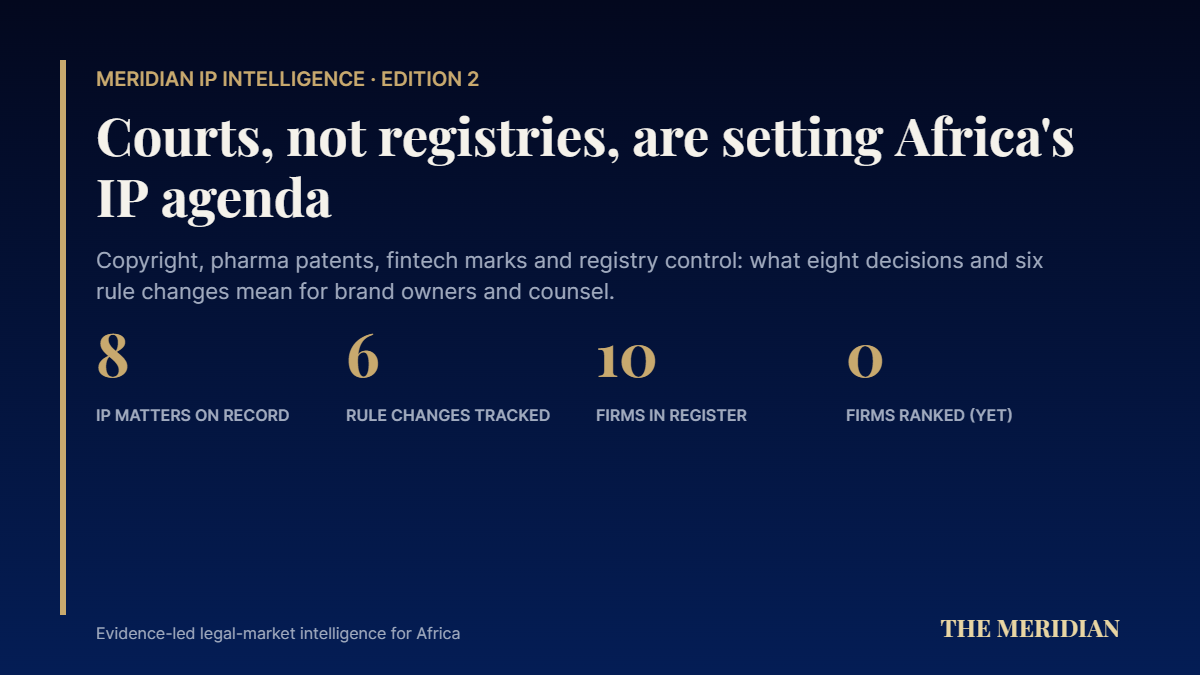
Contested IP matters and six rule changes across South Africa, Nigeria, Kenya, Egypt and the regional systems. Meridian has since published its first Africa IP ranking.
The second edition of Meridian’s Africa IP Intelligence records eight contested IP matters and six changes to the rules. Read together, they point one way: in 2026 the decisive moves in African IP have come from courts and tribunals, not from registries or legislators.
Copyright: the Constitutional Court draws the line
South Africa’s copyright reform has been stalled for years. On 26 June 2026 the Constitutional Court gave it a shape. In a majority judgment by Justice Mhlantla, the court held that copyright is property protected against arbitrary deprivation, upheld the move to fair use in section 12A of the Copyright Amendment Bill and the narrower exceptions in sections 12B, 12C, 12D(6) to (9), 19B and 19C, and struck down the broad educational exceptions in sections 12D(1) to (5). Neither Bill can be signed in its current form. The existing Copyright Act stays in force while Parliament redrafts. Read the record.
Patents: winning on validity, losing on remedy
In March the Supreme Court of Appeal upheld the University of California and Astellas’ South African patent for enzalutamide against Eurolab and Dis-Chem, rejecting invalidity challenges including on inventive step. It then declined interim relief because patients were already using the generic. The patentee is left with damages. For pharmaceutical patentees in South Africa, that is the lesson: a valid patent does not guarantee an injunction where patient access is at stake. Read the record.
In Nigeria, the patent story is about money and the payments system. Enterprise Logistics Special Ltd and its managing director are claiming N98.5 billion from the Central Bank of Nigeria, NIBSS, Avanage and the Registrar of Patents over cash-management technology. In July Justice Deinde Dipeolu urged settlement and set trial for 15 and 16 October. Tayo Oyetibo SAN leads for the plaintiffs. Read the record.
Marks and names: the state and the incumbent win
Three decisions show tribunals protecting established names. The Federal High Court in Abuja held in May that a private company could not own “eNaira”, because the name suggests government patronage, and granted the CBN’s counterclaim. South Africa’s Companies Tribunal ordered Times Square Hotel to drop a name confusingly similar to Sun International’s TIME SQUARE marks. And the Supreme Court of Appeal confirmed that a 27-year regional reputation was enough for Fire Logic to stop Fire Logik trading in the Cape. See the eNaira, Times Square and Fire Logik records.
Registries: the court keeps Kenya’s Registrar in charge
The one registry intervention in the record was reversed by a court. Kenya’s High Court quashed a ministerial directive that would have required Kenya Industrial Property Institute Board approval for registrations, renewals and revocations. Read the record. The rule changes that did take effect were administrative: ARIPO’s 2026 Banjul Protocol shortened the examination window for designated states from nine to six months from 1 March, and Egypt raised trade mark fees from 5 March.
What the evidence does not yet support
A ranking. Meridian requires two named, sourced IP matters with confirmed roles before a firm can be ranked. Adams & Adams has two matters on record, both cited in its Managing IP EMEA Awards 2026 recognition, but its side in each has not yet been confirmed against the judgments. Tayo Oyetibo LP has one. The rest of the register rests on awards and directory listings, which Meridian records as supporting evidence only. The record is also deepest in South Africa, because its courts publish quickly, and thinnest in OAPI’s francophone markets, where Meridian has no contested matter yet.
Firms with IP matters to put on the record can submit them for editorial consideration. Publication is not guaranteed.
Watch: ARIPO’s Director General on World IP Day 2026, on Meridian TV.


Leave a Reply