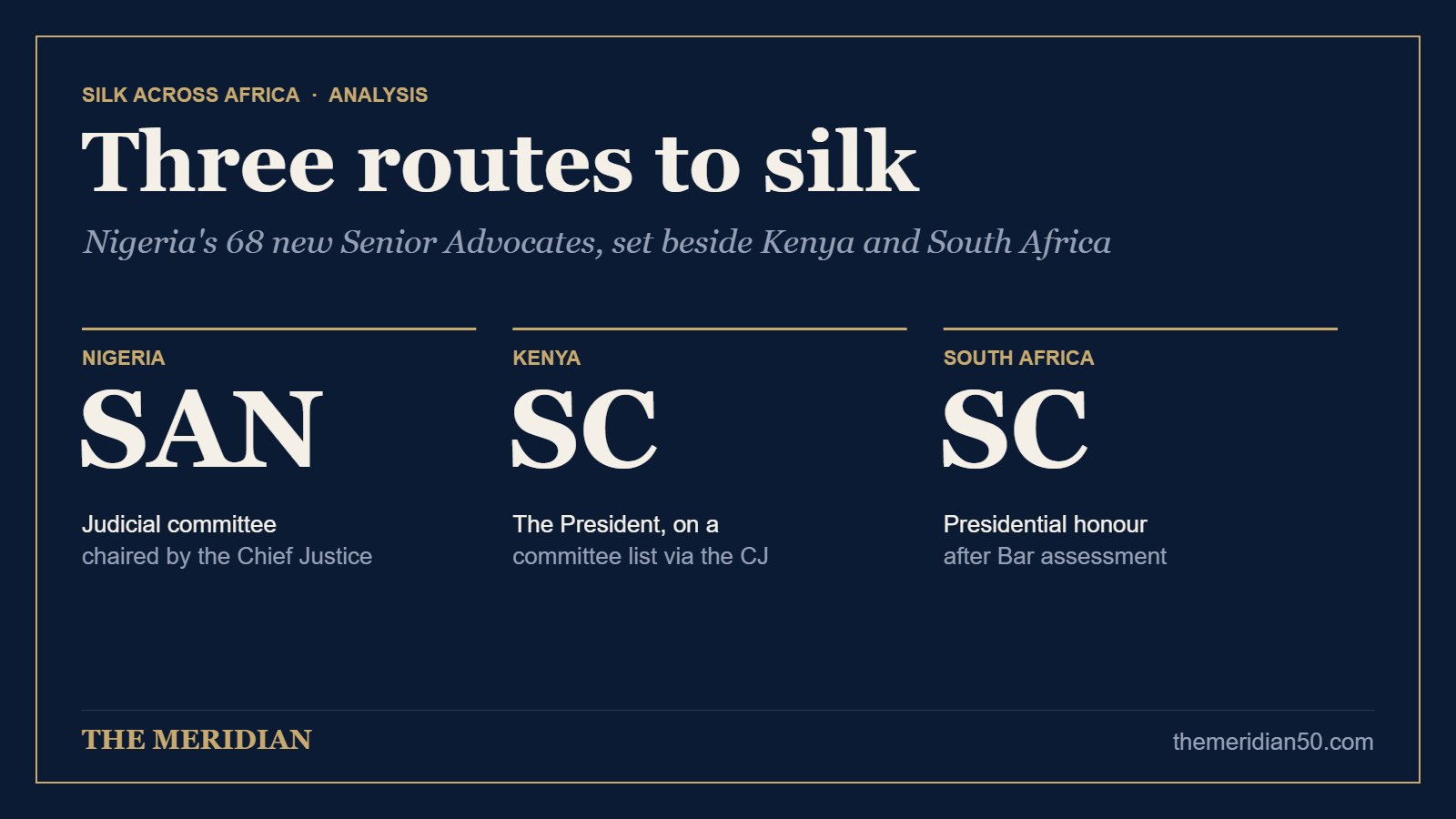
On Monday the Chief Justice of Nigeria swore in 68 Senior Advocates. Ten months earlier, Kenya’s President signed an order conferring Senior Counsel on 54 advocates. The letters after the names look alike. The gates that lead to them do not, and the difference matters to anyone who instructs, or competes with, senior counsel across African borders.
Coverage of Nigeria’s 2026 silk class has, rightly, looked inward: at the size of the class, the single academic, the petitions and the commercial firms that now count a Senior Advocate among their partners. The Meridian set out the domestic picture in The New Silks: Inside Nigeria’s 2026 SAN class. This piece looks outward. Set beside Kenya and South Africa, Nigeria’s process is one of three distinct models for conferring senior rank on the continent, and each model rewards a different kind of lawyer.
Three gates, three gatekeepers
| Nigeria | Kenya | South Africa | |
|---|---|---|---|
| Title | Senior Advocate of Nigeria (SAN) | Senior Counsel (SC) | Senior Counsel (SC) |
| Who confers | Legal Practitioners’ Privileges Committee, chaired by the Chief Justice | The President, on a list from the Committee on Senior Counsel submitted through the Chief Justice | The President, under the constitutional power to confer honours |
| Legal basis | Legal Practitioners Act, section 5; Privileges Guidelines | Advocates Act (Cap. 16), section 17; Senior Counsel Rules, 2011 | Constitution, section 84(2)(k), as interpreted in Mansingh |
| Minimum standing | Ten years at the Bar | Fifteen years | Not set by statute |
| What is tested | A documented record of judgments, including at the Court of Appeal and Supreme Court, plus interview and public comment | Irreproachable professional conduct and exemplary service to the legal and public service | Assessment by the Bars, recognised by the Head of State |
| Latest class | 68 sworn in on 12 October 2026 | 54 conferred on 10 December 2025 | Conferred periodically; no single national class |
Nigeria: the judicial gate
Nigeria is the only one of the three in which the judiciary both runs the process and makes the decision. The Legal Practitioners’ Privileges Committee, chaired by Chief Justice Kudirat Kekere-Ekun, approved this year’s class at its 174th plenary in Abuja on 23 July. The swearing-in followed on 12 October, at the ceremony marking the 2026/2027 legal year.
The test is evidential. Under the 2022 Guidelines, an advocate must put forward a body of decided cases, including five judgments from the Court of Appeal and four from the Supreme Court, and survive filtration, chambers inspection, a public comment window and an interview. The funnel this year ran from 89 shortlisted candidates (77 advocates, 12 academics) to 68 conferees (67 advocates, one academic). The 2025 class numbered 57: 56 advocates and one academic.
Get the next Meridian Briefing. Every Thursday at 11:00 AM.
Two consequences follow. First, the rank is a verified record of appellate advocacy rather than a general mark of eminence. Second, it is structurally out of reach for most transactional lawyers, however senior, because the work that defines their careers rarely produces a reported judgment. Nigerian silk tells a foreign client that a lawyer has won, lost and argued at the top of the court system. It says little about deal capability.
Kenya: the presidential gate, with a committee in front
Kenya created the Senior Counsel title in 2003. Under section 17 of the Advocates Act, the President grants the rank within sixty days of receiving a list of names from the Committee on Senior Counsel, submitted through the Chief Justice. Eligibility opens at fifteen years’ standing, five more than Nigeria requires. The statutory test is broader: irreproachable professional conduct and exemplary service to the legal and public service.
That breadth shows in the names. When President William Ruto signed the Investiture Order for 54 advocates, published in a special issue of the Kenya Gazette on 10 December 2025, the list included the Speaker of the National Assembly, Moses Wetang’ula, the Director General of the National Intelligence Service, Noordin Haji, and the academic and commentator PLO Lumumba, alongside practitioners.
The committee’s place in front of the President has been contested. In August 2025 the Advocates (Amendment) Bill, 2025, sponsored by the chair of the National Assembly’s Justice and Legal Affairs Committee, George Murugara, proposed letting the President confer the title on certain office holders, including the Chief Justice, the Attorney General and the Speakers of Parliament, without going through the committee. The Law Society of Kenya and the Senior Counsel Bar rejected the proposal in a joint statement, warning of two classes of Senior Counsel: one presidential, one peer-reviewed. The Meridian has not been able to confirm the Bill’s current status.
South Africa: the honours gate
In South Africa, silk is conferred by the President as an honour. That position was settled by litigation. An advocate, Ms Mansingh, argued that the constitutional power to confer honours did not extend to Senior Counsel status, and succeeded in the North Gauteng High Court. The Supreme Court of Appeal reversed that decision, reasoning that at the heart of silk lies recognition by the Head of State of an advocate’s integrity and excellence. The Constitutional Court dismissed her further appeal in Mansingh v General Council of the Bar [2013] ZACC 40, delivered on 28 November 2013.
The substantive assessment sits with the profession, through the Bars affiliated to the General Council of the Bar. The President’s role is recognition. The model therefore places professional judgment first and formal conferment last, the reverse of Nigeria’s single judicial decision.
What the comparison tells the market
The letters are not interchangeable. A SAN, a Kenyan SC and a South African SC each certify something different: a verified appellate record, a peer-and-presidential judgment of service, and a Bar assessment recognised by the Head of State. General counsel building a disputes team across Lagos, Nairobi and Johannesburg should read the rank as evidence of a particular kind of standing, then test the specific experience the matter needs.
Each model has a different pressure point. In Nigeria, the debate is about scale and prestige as classes grow. In Kenya, it is about who controls the gate, as the 2025 Bill showed. In South Africa, the executive’s role has already been tested in the Constitutional Court. None of these is a criticism of any individual conferee. They are features of the systems.
Transactional seniority has no equivalent marker. All three systems are built around advocacy and, in Kenya’s case, public service. The partners who lead Africa’s cross-border financings, acquisitions and restructurings hold no comparable title in any of them. That gap is one reason the market leans on deal records, client references and independent, evidence-based research to judge transactional standing.
Size comparisons need care. Nigeria conferred 68 in one sitting; Kenya conferred 54 in one order. The two figures sit in Bars of very different sizes and in systems with different eligibility floors, so they do not support a simple league table of selectivity. The Meridian has not found published, like-for-like application and success rates for Kenya or South Africa.
What to watch
- Whether Nigeria’s Privileges Committee revisits the academic route, which has produced a single conferee in each of the last two classes.
- The progress of Kenya’s Advocates (Amendment) Bill, 2025, and whether any future conferment bypasses the Committee on Senior Counsel.
- How firms with new silks present the rank to clients, within the publicity limits set by Nigeria’s Privileges Guidelines and Rule 39 of the Rules of Professional Conduct, 2023.
The full list of Nigeria’s 68 new Senior Advocates appears on The Meridian homepage.
Sources
- BusinessDay, 68 lawyers promoted to SAN rank as LPPC approves 2026 list, 24 July 2026
- ThisDay, LPPC approves elevation of 68 legal practitioners to rank of SAN, 23 July 2026
- ThisDay, LPPC shortlists 89 applicants for SAN rank, 24 June 2026
- The Impact Newspaper, CJN swears in 68 new Senior Advocates of Nigeria, 12 October 2026
- The Guardian (Nigeria), LPPC to elevate 57 lawyers to rank of SAN, 25 July 2025
- The Star (Kenya), Ruto confers Senior Counsel rank to 54 lawyers, 10 December 2025
- Advocates Act (Kenya), Cap. 16, section 17
- Eastleigh Voice, LSK, Senior Counsel Bar reject plan to give President sole power over Senior Counsel appointments, 15 August 2025
- Mansingh v General Council of the Bar and Others [2013] ZACC 40; 2014 (2) SA 26 (CC)



Leave a Reply